# three_cpp
**Repository Path**: zhouyanhang/three_cpp
## Basic Information
- **Project Name**: three_cpp
- **Description**: A port of three.js to C++
- **Primary Language**: C
- **License**: MIT
- **Default Branch**: master
- **Homepage**: None
- **GVP Project**: No
## Statistics
- **Stars**: 1
- **Forks**: 1
- **Created**: 2019-08-07
- **Last Updated**: 2022-01-07
## Categories & Tags
**Categories**: Uncategorized
**Tags**: None
## README
three.cpp
=========
### Status
[](https://travis-ci.org/jdduke/three_cpp)
#### A port of three.js to C++ #####
[three.js](http://mrdoob.github.com/three.js/) is a popular and
accessible 3D library (credits to mdroob and alteredq). The goal with three.cpp
is to fully implement the relevant portions of the library in C++11, up
to and including revision 50.
Before you start raging, see the [FAQ](#faq).
Note: As of Nov 17, 2013, this project has been seriously neglected for the better part of a year.
If there is demand, I (jdduke) would be happy to dust it off, clean up the code and get it back on track.
Feel free to message me privately if you have specific requests and/or ideas.
## Usage ##
three.cpp is optionally header-only; you can simply drop the
"three" folder in your project and get started, or you can compile it into a
static and/or dynamic library. For most kinds of development you will want to
use three.cpp as a library; header-only compiles are prohibitively expensive
for any kind of dynamic code base. The design is similar to that
found in [Boost Asio](http://www.boost.org/doc/libs/1_51_0/doc/html/boost_asio.html).
### Setup ###
* `git clone git://github.com/jdduke/three_cpp`
* `cd three_cpp`
### As header-only library ###
* All set. Relevant library source files are in **three_cpp/three**, simply include and use.
### As compiled library ###
* `mkdir build`
* `cd build`
* `cmake ../ -DTHREE_HEADER_ONLY:BOOL=OFF`
* `make` (or compile generated .sln with VC)
This generates the static library `three.{a/lib}` in **three_cpp/lib**, or the dynamic library `three.{dylib/so/dll}` in **three_cpp/bin**, dependent on the `THREE_LIBRARY_STATIC` CMake flag. Any code using the library must also define `THREE_SEPARATE_COMPILATION` when using three.cpp, and `THREE_DYN_LINK` if library is dynamic.
cmake-gui is useful if you need to configure SDL/GLEW path dependencies when compiling.
## Examples ##
Reviewing the examples in **three_cpp/examples** is probably the best way to learn how to use the library. Examples are built by default using the project files generated from CMake. To disable (assuming you're in **three_cpp/build**:
* `cmake ../ -DBUILD_THREE_EXAMPLES:BOOL=OFF`
Binaries are placed in **three_cpp/bin**.
## Sample code ##
This code creates a renderer, scene and camera, adds the camera and cube to the scene, then starts the rendering loop.
```c++
void scene() {
using namespace three;
auto renderer = GLRenderer::create();
auto camera = PerspectiveCamera::create(
75, renderer->width() / renderer->height(), 1, 10000
);
camera->position.z = 1000;
auto scene = Scene::create();
auto geometry = CubeGeometry::create( 200, 200, 200 );
auto material = MeshBasicMaterial::create(
Material::Paramaters().add( "color", Color(0xff0000) )
.add( "wireframe", true )
);
auto mesh = Mesh::create( geometry, material );
scene->add( mesh );
anim::gameLoop( [&]( float dt ) {
mesh->rotation.x += 0.1f * dt;
mesh->rotation.y += 0.2f * dt;
renderer->render( *scene, *camera );
} );
}
```
## Working examples ##


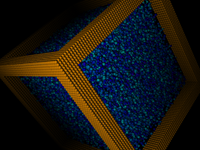


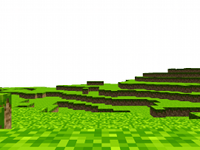
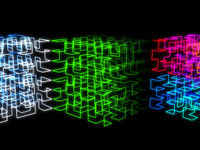
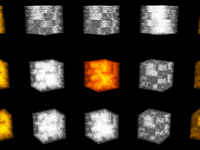






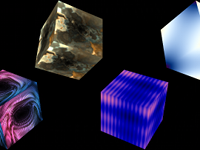

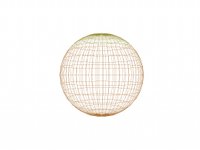 ## Status ##
This is very much a pre-alpha, early stages project: half-finished at best, with myriad TODO's and the like littered throughout. It's not pretty; effort was made to preserve the style/syntax/structure of the original library while not completely obviating the merits of native code . To be sure, this is as direct a port as possible; you will find things like public member variables, tight coupling and likely other code snippets that may or may not go against all you have come to believe in. C++ is *not* Javascript.
* **Core** - 75% complete?
* TODO: Morph targets, shadows, plugin support
* **Extras** - 5-10% complete?
* TODO: Pretty much everything
* **Examples** - 25% complete?
* TODO: Examples involving morph targets and/or model/json importing
### Performance ##
For the examples that have been ported, perf is anywhere from 2x-12x that of
three.js + WebGL on the latest Chrome version, averaging 4-5x, on my i7, GT 650m laptop (vsync disabled on both, of course). No thorough profiling or meaningful optimization has been done, and the graphics path is more or less identical to
that found in three.js.
TODO: Test with GLES (Android/iOS/NACL)
## Dependencies ##
* CMake
* SDL and GLEW for the examples (included for both MSVC and MinGW)
* At the moment, these are required to build the library; this dependency will be optional in the future.
## Supported Platforms ##
You'll need a sufficiently modern C++11 compiler:
* >= Clang 3.1
* >= GCC 4.6.3
* MSVC 2012
Implemented functionality tested via examples, and working on:
* Mint 13 with GCC 4.6.3
* Win 7 with both MSVC 2012 and MinGW (GCC 4.8 and 4.7)
* OSX with GCC 4.7.2 and Clang 3.1
Some examples might be a little flaky on any given platform.
* MSVC 2012: This has been just a pain to support (no variadics, no initializer lists, no default/deleted functions, no constexpr etc...), and support may be dropped at some point in the future. Update: With the November 2012 CTP, things have improved a great deal;
* OSX: VSync is on for all samples, I haven't bothered to take a closer look.
## FAQ ##
* Why on earth would you do this?
* It started as an exercise to 1) dive into a popular Javascript library of
medium size, 2) play with C++11 and 3) offend as many programmers as possible.
* But, but, C++ is so... its very existence troubles my spirit... why not target awesome language X?! Why, why C++?
* For the kids.
* Why is it complaining about SDL on 64-bit Win builds?
* CMake is likely pulling in 32-bit libraries. You can manually change the *${SDL_LIBRARY}* and *${SDLMAIN_LIBRARY}* CMake variables to refer to the proper libraries; simply change the **lib** directory reference to **lib64** if using the provided SDL implementation in **externals**.
## Status ##
This is very much a pre-alpha, early stages project: half-finished at best, with myriad TODO's and the like littered throughout. It's not pretty; effort was made to preserve the style/syntax/structure of the original library while not completely obviating the merits of native code . To be sure, this is as direct a port as possible; you will find things like public member variables, tight coupling and likely other code snippets that may or may not go against all you have come to believe in. C++ is *not* Javascript.
* **Core** - 75% complete?
* TODO: Morph targets, shadows, plugin support
* **Extras** - 5-10% complete?
* TODO: Pretty much everything
* **Examples** - 25% complete?
* TODO: Examples involving morph targets and/or model/json importing
### Performance ##
For the examples that have been ported, perf is anywhere from 2x-12x that of
three.js + WebGL on the latest Chrome version, averaging 4-5x, on my i7, GT 650m laptop (vsync disabled on both, of course). No thorough profiling or meaningful optimization has been done, and the graphics path is more or less identical to
that found in three.js.
TODO: Test with GLES (Android/iOS/NACL)
## Dependencies ##
* CMake
* SDL and GLEW for the examples (included for both MSVC and MinGW)
* At the moment, these are required to build the library; this dependency will be optional in the future.
## Supported Platforms ##
You'll need a sufficiently modern C++11 compiler:
* >= Clang 3.1
* >= GCC 4.6.3
* MSVC 2012
Implemented functionality tested via examples, and working on:
* Mint 13 with GCC 4.6.3
* Win 7 with both MSVC 2012 and MinGW (GCC 4.8 and 4.7)
* OSX with GCC 4.7.2 and Clang 3.1
Some examples might be a little flaky on any given platform.
* MSVC 2012: This has been just a pain to support (no variadics, no initializer lists, no default/deleted functions, no constexpr etc...), and support may be dropped at some point in the future. Update: With the November 2012 CTP, things have improved a great deal;
* OSX: VSync is on for all samples, I haven't bothered to take a closer look.
## FAQ ##
* Why on earth would you do this?
* It started as an exercise to 1) dive into a popular Javascript library of
medium size, 2) play with C++11 and 3) offend as many programmers as possible.
* But, but, C++ is so... its very existence troubles my spirit... why not target awesome language X?! Why, why C++?
* For the kids.
* Why is it complaining about SDL on 64-bit Win builds?
* CMake is likely pulling in 32-bit libraries. You can manually change the *${SDL_LIBRARY}* and *${SDLMAIN_LIBRARY}* CMake variables to refer to the proper libraries; simply change the **lib** directory reference to **lib64** if using the provided SDL implementation in **externals**.